
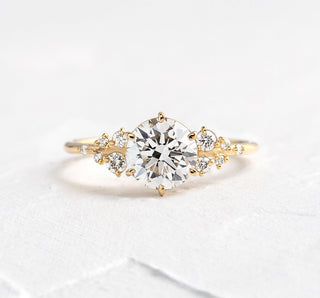



Shopping for a ring without knowing what things actually cost is stressful, so let's fix that upfront. This guide breaks down diamond engagement rings for women with price ranges by carat weight, from small accent stones under a carat to larger center stones over two carats. You'll see how the 4Cs, cut, color, clarity, and carat, each move the price up or down, and why two rings that look similar in a photo can cost very differently. We'll also cover metal costs (platinum versus gold), how setting style changes the final price, practical ways to stretch your budget without sacrificing quality, and common financing options if you'd rather spread out the cost. By the end, you'll have a real number in mind instead of a guess, and you'll know exactly which corners are safe to cut and which ones aren't. Let's start with what actually drives the price.
What Determines Diamond Engagement Ring Prices
Two rings can look nearly identical side by side and still be thousands of dollars apart. Diamond engagement ring prices come down to four things working together: the diamond itself, the metal, the setting style, and where you buy it. Miss any one of these and your budget estimate will be off.
The diamond is usually 60 to 80 percent of the total cost. The metal and setting make up the rest, and labor for custom or detailed work adds more on top. Buying from a jeweler with lower overhead, like one that skips a large retail markup, can also shift the price without changing quality at all.
Diamond Quality and Price: Understanding the 4Cs
Diamond quality and price move together, but not evenly. Some factors affect price a lot, others barely move the needle.
-
Carat weight: Price jumps sharply at whole and half-carat marks (0.90 vs. 1.00 carat), since demand clusters around round numbers.
-
Cut: This affects sparkle more than any other factor. An Excellent cut can cost more, but it's the one factor GIA research consistently ties to how bright a diamond actually looks.
-
Color: Grades from D to Z measure how colorless a diamond is. Most buyers can't see a difference between G and I with the naked eye, but the price gap between them is real.
-
Clarity: Internal marks that affect price more than appearance in most cases. VS2 and SI1 diamonds often look clean to the eye and cost noticeably less than VVS grades.
If your budget is tight, cut is where quality matters most and clarity is usually where you can save the most.
Engagement Rings for Women by Price Range
Here's a rough breakdown of what buyers typically spend, based on center stone size and quality tier.
|
Price Range |
What You Typically Get |
|
1,500–3,000 |
0.50–0.75 carat center stone, good cut, SI clarity, 14K gold or white gold |
|
3,000–6,000 |
0.75–1.25 carat center stone, very good to excellent cut, VS clarity |
|
6,000–12,000 |
1.25–2.00 carat center stone, excellent cut, VS+ clarity, platinum options |
|
$12,000+ |
2.00+ carats, top color and clarity grades, or a fancy shape with added detail work |
These ranges shift with market conditions, so treat them as a starting point rather than a fixed number. Engagement rings for women vary just as much by personal taste, since a solitaire and a halo at the same price point can look and feel completely different.
Metal and Setting Costs
The center diamond gets most of the attention, but metal choice can shift your total by a few hundred dollars either way.
|
Metal |
Typical Cost Impact |
Notes |
|
14K White or Yellow Gold |
Baseline |
Most affordable, still durable for daily wear |
|
18K Gold |
Slightly higher |
More gold content, richer color |
|
Platinum |
Highest |
Denser metal, holds stones securely, doesn't need replating |
Setting style adds its own cost. A plain solitaire is the cheapest option. A halo or pavé band adds small accent diamonds, which raises the price but also adds visible sparkle without needing a larger center stone.
Engagement Ring Price Guide by Carat Weight
If you're shopping mainly by size, this engagement ring price guide gives a rough starting point per carat, assuming good cut and SI clarity:
-
0.50 carat: roughly 1,200–2,000
-
1.00 carat: roughly 4,000–7,000
-
1.50 carat: roughly 7,000–12,000
-
2.00 carat: roughly 12,000–20,000+
Price per carat rises faster than size, since larger rough diamonds are rarer to begin with. A 2-carat diamond usually costs more than two separate 1-carat diamonds combined.
Ways to Get More Ring for Your Budget
A few adjustments can stretch your budget without making the ring look cheaper:
-
Choose a slightly lower clarity grade (SI1 instead of VS1) if the diamond is eye-clean under a loupe
-
Pick a color grade in the G-H-I range instead of chasing a colorless D-E-F grade
-
Consider a halo setting to make a smaller center stone look larger
-
Buy just under a round-number carat weight (0.90 instead of 1.00) for a meaningful price drop with almost no visible size difference
Financing and Payment Options
Most jewelers, including us, offer payment plans for larger purchases. We do in-house installments, often interest-free if you pay it off within a set window. Some customers go through third-party financing instead, which stretches the term out longer but usually adds interest based on your credit. And if you're buying ahead of a proposal date, layaway lets you pay in stages before you actually take the ring home.
Whichever route you pick, ask what the total comes to with interest included. That number is the one that actually matters, not the monthly payment.
Final Thoughts
Price on a diamond ring rarely comes down to one number you can look up and trust. Carat, cut, color, and clarity pull in different directions at once, metal and setting add their own cost, and a few smart trade-offs can stretch your budget further than most people expect. If you keep one thing in mind while comparing diamond engagement rings for women with price tags all over the place, let it be this: quality and price move together, but not always in the ways you'd assume. At Aurous Fine Jewelry, we walk every customer through these numbers honestly, so you know exactly what you're paying for and why.
Frequently Asked Questions
What's a reasonable budget for a diamond engagement ring?
There's no fixed rule, but many buyers land between $3,000 and $6,000 for a solid quality diamond around one carat. Your budget should reflect what's comfortable for you, not a formula.
Does a bigger diamond always mean a better ring?
No, and this trips up a lot of first-time buyers. A well-cut smaller diamond can throw off more light and look more impressive on the hand than a bigger stone with a mediocre cut. Size gets the attention, but cut is doing most of the actual work.
Is it cheaper to buy loose diamonds and a setting separately?
It can be, if you already know exactly what you want and you're comfortable coordinating the fit yourself. Most people end up buying both together anyway, mainly because it comes with a cleaner warranty and fewer things that can go wrong at the fitting stage.
How much does the setting typically add to the price?
Depends heavily on style. A plain solitaire might only add a few hundred dollars. A detailed halo or vintage design with hand-finished milgrain work can add a lot more, since that's paying for labor as much as material.
Should I buy a certified diamond?
Always. A grading report from GIA or AGS is what actually backs up the quality claim on the diamond, not just the price tag. Skip it, and you're taking someone's word for it. Get it, and you've got something to point to later if you ever need to resize, insure, or resell the ring.