
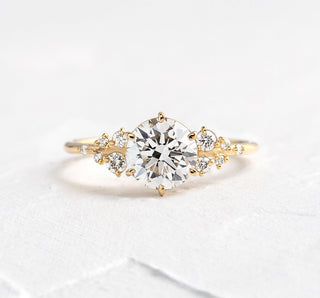



A marquise diamond has two pointed tips, and that shape is exactly why pairing it with a wedding band takes more thought than a round or cushion cut would. This guide covers why curved and contour bands are usually the better fit, when chevron bands make sense for a snug, no-gap look, when a plain straight band works fine, and how to decide between matching metals or mixing them. You'll also find pairing ideas by style, from vintage stacks to clean modern sets, plus sizing tips that prevent a costly reorder. By the end, choosing a marquise diamond engagement ring and wedding band that sit together well will feel a lot less like guesswork. Let's start with why this pairing needs extra care in the first place.
Why Pairing a Marquise Diamond Engagement Ring and Wedding Band Takes Extra Thought
Round and cushion cuts have even, rounded edges, so almost any wedding band sits flush against them. A marquise diamond engagement ring is different: the elongated shape tapers into two sharp points at the top and bottom, and a plain straight band can leave small triangular gaps beside those points.
That gap isn't a flaw, it's just physics, curved stone meeting a straight edge. The fix is choosing a band shaped to follow the curve of the marquise, or accepting a small gap if you prefer a more classic, separated stack.
Curved and Contour Bands: The Safest Bet
Contour bands are cut with a gentle curve that hugs the base of the center stone. For a marquise diamond engagement ring, this is usually the first style a jeweler suggests, since it closes the gap at the widest part of the stone and lets the two rings sit almost like one piece. It's the marquise engagement ring wedding band combo we recommend most often to first-time buyers.
-
Works well with prong, bezel, and halo settings
-
Easier to resize later than a fully custom-shaped band
-
Can be created to match an existing engagement ring, even one purchased elsewhere
-
Still leaves a sliver of a gap near the pointed tips, which most people don't notice once worn together
If you want your rings to look like a matched set from day one, this is one of the more reliable wedding bands for marquise rings you can choose.
Chevron and V-Shaped Bands for a Closer Fit
A chevron band takes the curve idea a step further. Instead of a soft dip, it forms a sharp V that mirrors the pointed tips of the marquise stone directly. This is the closest a band can get to fully cradling the diamond's shape.
Chevron bands work best when:
-
The engagement ring has a low or medium profile setting
-
You want zero visible gap between the two rings
-
The wedding band will be worn stacked, not on its own
The trade-off is flexibility. A chevron band is cut to match one specific ring, so it won't slide onto a differently shaped stone later if styles change. It's a marquise engagement ring wedding band pairing built for permanence, not for mixing and matching.
When a Straight Band Actually Works
Not everyone wants a perfectly seamless fit, and that's fine. A plain straight band creates a small visible gap under the marquise points, but some people like that look. It reads as more classic, less fused together, and it gives you the freedom to wear the wedding band alone on nights out.
Straight bands also tend to be more affordable, since they're a stock shape rather than a custom curve. If budget matters more than a flush fit, this is a completely reasonable choice.
Matching Metals or Mixing Them
Once you've settled on a shape, metal is the next decision.
|
Approach |
Look |
Best For |
|
Same metal, same tone |
Seamless, traditional |
Couples who want one cohesive set |
|
Same metal, different finish |
Subtle texture (matte vs polished) |
Couples who like small contrast |
|
Mixed metals |
Two-tone, modern |
Couples building a stack over time |
There's no wrong answer here. Matching metals is safer if you're not sure yet, since you can always add a mixed-metal band later. Mixing early works if you already know you want a layered, collected-over-time look.
Marquise Ring Pairing Ideas by Style
If you're still picturing the final look, these three combinations cover most tastes:
Vintage stack: A marquise solitaire with a milgrain contour band in yellow or rose gold. The soft detailing on the band echoes the elongated, old-world shape of the stone.
Modern minimal: A marquise solitaire or thin-pavé setting with a plain curved band in platinum or white gold. Clean lines, no extra texture, nothing competing with the diamond.
Bold stack: A marquise halo ring with a chevron band set with its own small diamonds. This is the closest fit option and reads the most intentional, like the two rings were designed together.
These marquise ring pairing ideas aren't exhaustive, but they're a solid starting point if you're not sure where to begin.
Getting the Fit and Sizing Right
A few practical notes on wedding bands for marquise rings before you buy:
-
Bring the engagement ring in when shopping for the band. Fit against the actual stone matters more than a size number.
-
Ask about "matching" versus "coordinating." A matching band is shaped for your specific ring; a coordinating band is a similar style that isn't custom-fitted.
-
Mention upfront if you plan to solder the rings together eventually, since some contour shapes solder more cleanly than others.
-
Resize the wedding band before the wedding, not after. A resized contour band can lose its exact curve.
Final Thoughts
A marquise diamond engagement ring and wedding band don't need to be complicated to get right. Curved and chevron bands solve the gap issue for anyone who wants a seamless look, straight bands work fine if you don't mind a small space, and metal choice comes down to personal taste more than any strict rule. At Aurous Fine Jewelry, we fit every wedding band to the exact engagement ring it's paired with, so the two sit together the way they're meant to from the very first day you wear them.
Frequently Asked Questions
Do all marquise rings need a curved wedding band?
No. A curved or chevron band closes the gap near the pointed tips, but plenty of people choose a straight band and don't mind the small space it leaves.
Can I get a wedding band custom-fitted to a marquise ring I bought elsewhere?
Yes. Most jewelers, including us, can create a contour or chevron band to match an engagement ring purchased somewhere else, as long as we can measure the existing setting.
Is a chevron band harder to resize than a curved band?
Generally yes, because it's cut to match the exact angle of one ring's points. A gentler contour band has a bit more flexibility during resizing.
Will mixing metals between my engagement ring and wedding band look odd?
Not if it's intentional. Two-tone pairings are common and tend to look more like a deliberate stack than a mismatch, especially when one metal repeats somewhere else in the setting.
Should I buy the engagement ring and wedding band at the same time?
It's not required, but bringing the engagement ring with you when shopping for the band makes it much easier to get a precise fit, especially with a marquise shape.