
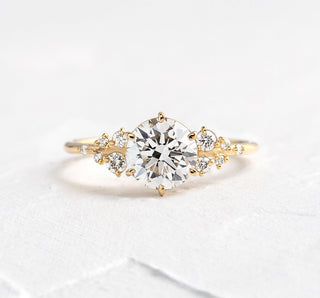



If you scroll through a hundred engagement ring photos, you'll notice something. Trends come and go, but a handful of styles keep showing up decade after decade. That's the whole idea behind timeless classic engagement rings: they're not chasing a moment, they're built for a lifetime. This guide walks through why the solitaire still wins over so many couples, how halo settings make a smaller diamond look bigger, why three-stone rings carry meaning beyond their sparkle, and where vintage-inspired details fit into a modern proposal. We also cover why the round diamond shape has outlasted every other fashion cycle, plus how to pick a metal and setting that will still feel right in twenty years. By the end, you'll know exactly which classic engagement rings suit your taste and your life, not just this year's Pinterest board. Let's get into the details.
What Makes Timeless Classic Engagement Rings So Special
A ring earns the word "timeless" when it looks just as good in an old photograph as it does today. Think of your grandmother's ring, or a portrait from the 1950s. The rings that still turn heads share a few traits: clean lines, a focal diamond that isn't hiding behind trendy details, and craftsmanship that holds up to daily wear. Fashion rings chase the moment. This style chases something steadier, a design that won't make you wince when you look back at photos in fifteen years.
Classic settings also tend to hold their resale and sentimental value better, because jewelers and buyers alike recognize good proportions long after a micro-trend has faded.
The Solitaire: Still the Most Requested Style
Ask any jeweler what people want first, and the answer is usually the same: a single diamond on a plain band. The solitaire strips everything down to the stone itself, no distractions, no competing details.
-
Works with almost any diamond shape (round, oval, cushion, emerald)
-
Easy to pair with a wedding band later
-
Low profile, so it doesn't snag on clothing or hair
-
Ages well because there's nothing "trendy" to date it
It's usually the safest bet if you want one ring that will never look out of place, and it's exactly why it remains one of the most searched elegant engagement rings year after year.
Round Diamond Engagement Rings: Why This Shape Never Fades
Out of every diamond cut available, the round brilliant keeps winning. This single cut accounts for the majority of all engagement ring sales, and there's a reason beyond tradition. Its 58 facets are arranged to bounce light back to the eye, which is why it consistently shows more fire and sparkle than fancier shapes under the same lighting. The Gemological Institute of America notes that the modern round brilliant cut was mathematically refined by Marcel Tolkowsky in 1919, and that same formula still guides how most round diamonds are cut today.
Because the round shape flatters almost every hand and setting style, it pairs beautifully with halos, pavé bands, and simple solitaires alike. If you're torn between shapes, round diamond engagement rings are the one choice you're unlikely to regret later.
Halo Settings: Old Idea, Modern Comeback
Halo rings surround the center stone with a ring of smaller diamonds. It's not a new idea. Georgian and Victorian jewelers used this technique centuries ago, often to make a modest-sized gem look far more impressive under candlelight.
Today, the halo does the same job. It makes a center diamond appear noticeably larger and adds extra sparkle from every angle, without needing to size up your center stone (or your budget). This is one of the timeless engagement ring styles that manages to feel both vintage and current at once, which is probably why it never really leaves the shortlist.
Three-Stone Rings: A Design With a Story
A three-stone ring isn't just a pretty layout, it's one of the more elegant engagement rings you can pick for the meaning built into it. Traditionally, the three stones represent a couple's past, present, and future together, which is part of why this design has stuck around for well over a century.
That symbolism also comes with flexibility. You can mix diamond shapes, use colored side stones, or vary the sizes to create a design that stays traditional while feeling personal to the couple wearing it.
Vintage and Art Deco Details: Character Without Going Out of Style
Not every timeless design is plain. Art Deco rings from the 1920s and 30s brought in geometric patterns, milgrain edges, and filigree work, and those same details are back in heavy demand right now. The trick with vintage-inspired rings is balance: enough detail to feel special, not so much that the ring looks busy or dated in ten years. Milgrain edging, filigree scrollwork, and cathedral settings add texture and history without pulling attention away from the diamond itself, which keeps them feeling enduring rather than like passing fashion.
Choosing Metal and Setting That Age Well
Metal choice matters just as much as the setting for long-term wear.
|
Metal |
Why It Lasts |
Best For |
|
Platinum |
Naturally white, holds prongs securely |
Daily wear, active lifestyles |
|
18K White Gold |
Bright finish, needs occasional replating |
Classic solitaire and halo styles |
|
18K Yellow Gold |
Warm tone, ages gracefully |
Vintage and Art Deco designs |
|
Rose Gold |
Softer hue, flatters most skin tones |
Romantic, vintage-inspired settings |
A Few Questions to Narrow Down Your Style
-
Daily wear or minimal jewelry? Low settings suit active hands.
-
Simple and clean, or detailed and ornate? This points you toward solitaire versus vintage.
-
Is resale or heirloom value a priority? Round diamonds and platinum hold value best.
-
What's your budget? A halo can make a smaller stone look larger for less than upgrading the diamond itself.
Answer those honestly, and you'll land on one of these timeless engagement ring styles without second-guessing yourself later.
Final Thoughts
Trends will keep cycling through jewelry stores and social feeds, and some will look dated within a year or two. Solitaires, halos, three-stone designs, and vintage detailing have already survived a century of changing fashion. At Aurous Fine Jewelry, we craft each ring with that same long view in mind, so what you choose today still feels right decades from now.
Frequently Asked Questions
What makes a ring "timeless" instead of just "classic"?
A classic ring reflects a well-established design. Timeless goes a step further, meaning the design hasn't dated across multiple decades and still photographs and wears well today.
Are round diamonds always more expensive than other shapes?
Generally yes, because round diamonds require more rough material to cut and produce less waste-efficient yields than shapes like oval or cushion. That said, the extra brilliance is why so many buyers still choose round over other shapes.
Is a solitaire too plain for an engagement ring?
Not at all. A solitaire is simple by design, but "simple" isn't the same as "boring." Many buyers add a detailed wedding band later to introduce more texture once the two rings sit together.
Do vintage-style rings cost more than modern designs?
It depends on the detailing. Filigree and milgrain work require more hand-finishing time, which can add to labor cost, but the center diamond usually drives the overall price more than the style of the setting.
How do I know which metal will hold up best?
Platinum holds up the longest. It won't need replating, ever, but you'll pay for that upfront. White gold is the trade-off option: cheaper going in, but expect a rhodium touch-up every few years to keep that bright white finish. Yellow and rose gold skip that maintenance question entirely. They just soften over time, and honestly, a lot of people end up liking that aged look more than a mirror-polish finish.
Can I combine styles, like a vintage halo with a modern band?
Yes, and it's actually common. Many of our clients mix a vintage-inspired halo with a clean, modern shank so the ring feels personal instead of copied from a catalog.